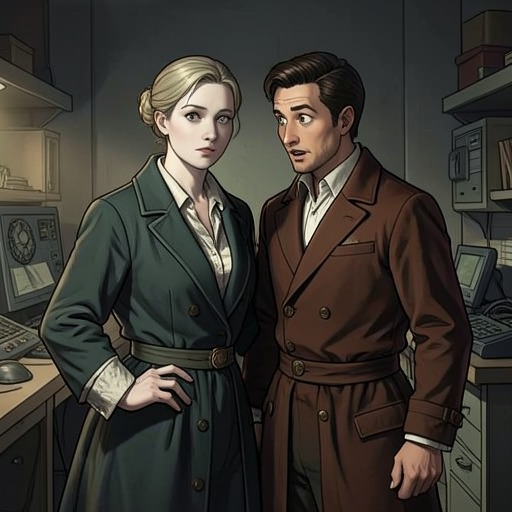
John rejects Lenina after the feelie
Brave New WorldJohn rejects Lenina after the feelie at the point where their attraction seems ready to become physical, but the scene ends with separation instead. The contrast between Lenina’s lingering pleasure and John’s shame makes his refusal more than a rebuff: it exposes how differently they understand desire, intimacy, and what a person ought to permit themselves.
The feelie and its lingering effects
Lenina and John watch the stereoscopic feelie in pneumatic stalls, where the experience is designed to enlist more than sight. Lenina tells John to take hold of the metal knobs on his chair to receive the effects. The film’s images, synthetic voices, and sensory accompaniments construct an intensely physical spectacle; its story ends with the rescued Beta blonde becoming the mistress of the three Alphas who save her. For Lenina, the show’s erotic sensations continue after the lights come up. As the crowd shuffles toward the lifts, the last kiss still seems to flutter against her lips and trace shuddering paths of anxiety and pleasure across her skin.
That bodily aftermath sets the terms of the encounter. Lenina, flushed, catches John’s arm and presses it against her side. He looks at her with desire, pain, and shame, then disengages his arm. His response does not mean that he feels nothing: the narration makes attraction unmistakable. Instead, desire intensifies his fear that he may fail to live up to an ideal he has placed between himself and Lenina. The scene’s tension comes from the collision between an experience designed to make sexual pleasure immediate and John’s effort to treat desire as something that should be governed by restraint.
The argument over the film
John tells Lenina that she ought not to see such things and identifies the film as horrible. She is genuinely astonished; she had thought it lovely. When he calls it base and ignoble, she still does not understand what he means. The exchange exposes a difference that their shared viewing has not bridged: Lenina accepts the feelie’s pleasures as enjoyable, while John judges its erotic display by a moral standard foreign to her response.
John also shifts blame away from Lenina herself and toward the surrounding circumstances, as though the film might occasion a lapse from the perfection he seeks. That displacement reveals the delicacy of his position. He is attracted to her, yet fears that acknowledging or acting on that attraction would make him unworthy of the image he has formed of her. Lenina, meanwhile, cannot see why he would go out of his way to spoil what she considers a pleasurable evening. Their disagreement is not resolved by explanation; it deepens into silence.
The failed expectation
During the taxicopter ride, John hardly looks at Lenina. He sits turned away, bound by vows that have never been spoken and by laws that no longer govern the world around him. His whole body sometimes shakes with a sudden nervous start, giving physical form to the strain that he cannot settle through conversation. Lenina reads the ride differently. She is exultant at the prospect of finally being alone with him and assumes that, despite his oddness, he is about to accept the intimacy she expects.
On the roof of her apartment house, Lenina checks her appearance in a small hand mirror while John pays the driver. She notices that her nose is shiny and powders it, thinking that John is very good-looking and that there is no reason for him to be shy. The mirror marks the ordinary, practical confidence of her expectation; she sees a brief delay before the encounter she anticipates, not a moral crisis. Her smile at her reflection contrasts with John’s hesitation and the extraordinary thoughts she cannot imagine him having.
Departure and significance
John says good-night in a strangled voice. Lenina turns, surprised, and begins to ask whether he is not staying. He shuts the cab door and bends forward to speak to the driver; the taxicopter shoots upward before she can make sense of his decision. Looking down through the floor window, John sees Lenina’s upturned face, pale in the bluish lamplight, her mouth open as she calls after him. Her figure recedes, and the roof seems to fall away into darkness.
The departure completes the scene’s reversal: Lenina approaches the evening as the long-awaited start of physical intimacy, while John ends it by leaving. His refusal does not cancel his desire; the painful force of the scene depends on their coexistence. Nor does Lenina comprehend the standard by which he judges himself. Their separation therefore shows the personal cost of two incompatible ways of organizing sexuality: Lenina’s confidence in immediate pleasure and John’s struggle to reconcile attraction with ideals of restraint. The feelie’s simulated intimacy gives way to an actual encounter in which neither can meet the other on shared terms.